It's Not the Best Learners Who Succeed — It's the Best Doers!
I wrote this article based on notes I took while trying to manage my own time better. I hope it helps you too. ❤
Time Investment and Management
Say we sign up for a course, or we're studying something. We need to write down our expectations and what we expect to gain from it. Doing this means we're using our time actively, and that's how we make a time investment.
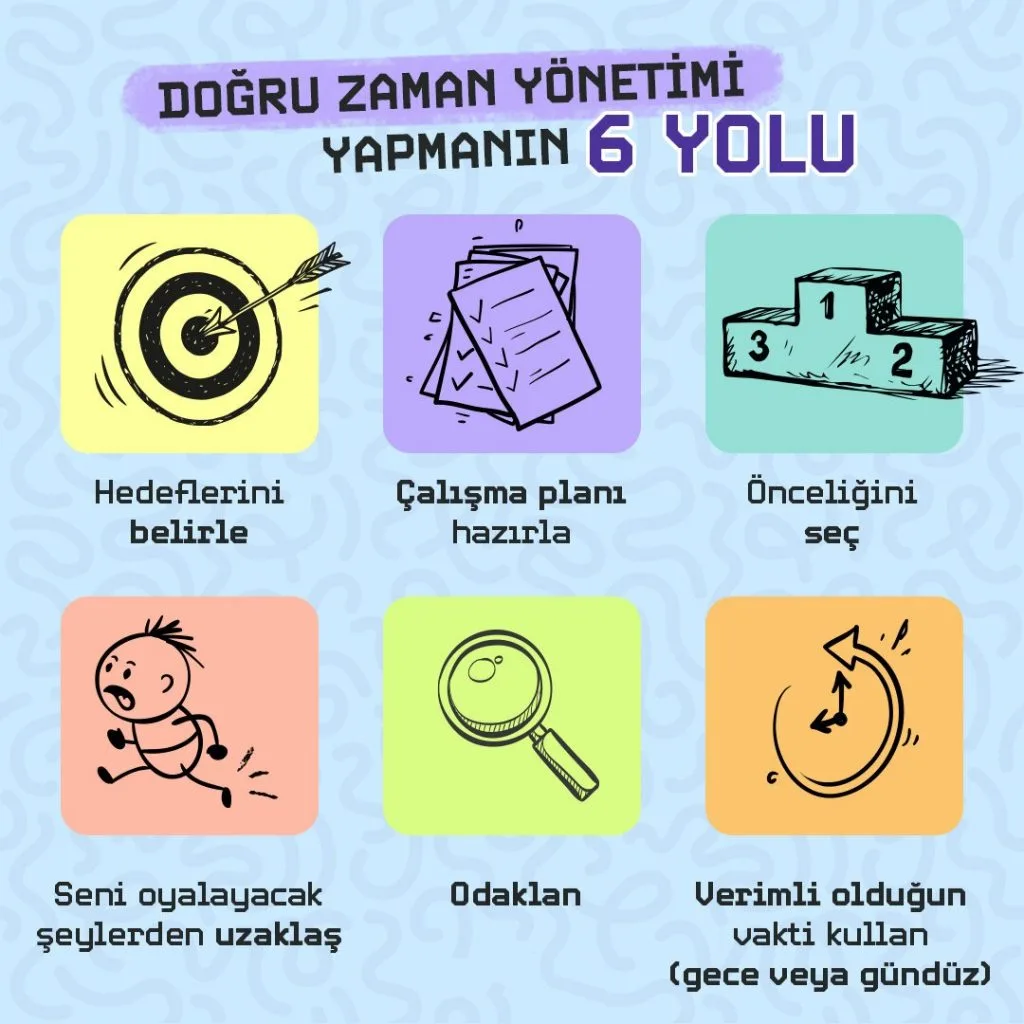
Planning matters enormously in time management. If you can get the plan to sink into your brain, you become far more likely to actually perceive time. This is what activates our attention skills, and that's how we end up actually managing our time.
 via Genç Motto
Activation Energy (the Striatum)
This is the high triggering energy required to get an event or task started. After that, only a small amount of energy is needed to keep it going. We call this activation energy. If we can make good use of the striatum (the part of the brain responsible for planning), we get one step closer to our goals.
Not doing a task we need to do, or failing to act, triggers fear and stress receptors in the brain.
The task starts to look dangerous. The brain protects itself, and it won't give you permission to do it.
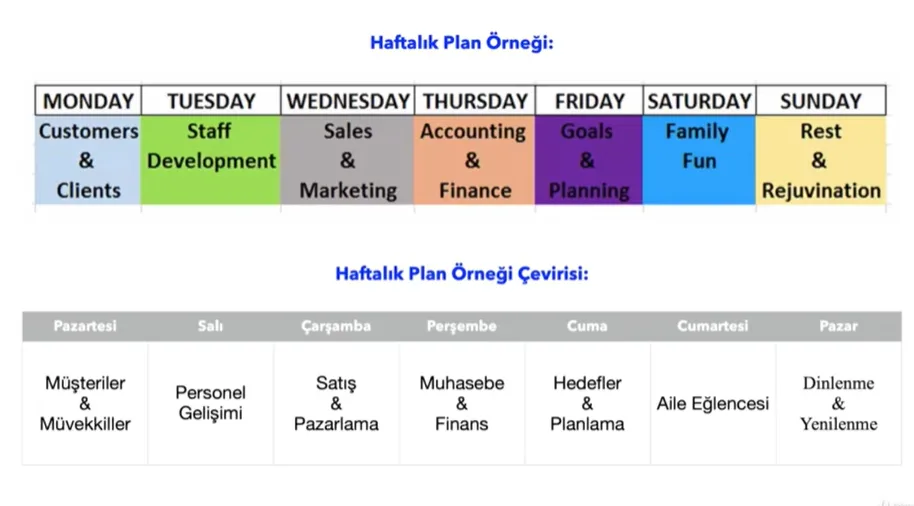 Jack Dorsey (Founder of Twitter/X) — Example Weekly Plan
Planning lets you see what's ahead for that activation energy. Good planning helps us actually capture it.
- Planning builds self-confidence.
- Planning reduces stress and waste.
- Planning keeps you hopeful.
Parkinson's Law
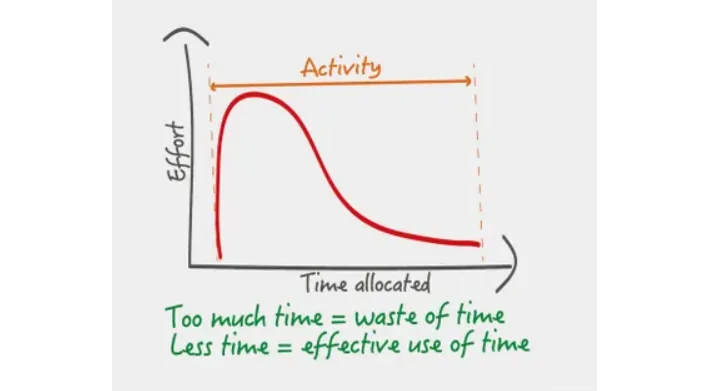
Parkinson's Law is a principle that highlights the inefficiency we experience when we give a task more time than it needs.
- Parkinson's Law says: "Work expands to fill the time available for its completion."
- If the deadline for a task is far away, the brain protects itself and refuses to spend effort on it right now.
- Finishing a task brings emotional relief. When you have long tasks ahead of you, break them up and finish them one at a time.
 via Parkinson's Law — Pierre Pichère
To apply this law, you need to break your work down and start with concrete target steps. Once you've split it into small daily pieces, you're expected to do your piece every day. If you don't, giving yourself a penalty you genuinely don't want gives you the push you need to actually do the work.
Let's Give an Example
When applying this law, if you set something you don't want as the penalty for yourself, it can be a lot more motivating 😄
Task: Read 300 pages total
Book: Nineteen Eighty-Four (1984) — Author: George Orwell
Pages to Read Each Day: 50 — Penalty: Give my brother some money 🙂
Pomodoro (Taking Breaks)
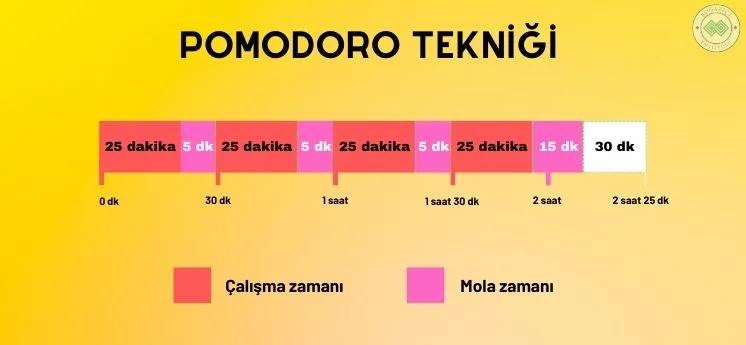
The photo below actually makes this technique clearer than words can, and it can genuinely help your productivity. There's just one rule: during your breaks, stay away from social media or other tasks. Walking, lying down — resting your brain and body — really matters.
 via Boğaziçi University
The Most Effective Time Management Techniques
Simple Tactics (Short Notes I've Collected)
- Do your hardest and most important work in the mornings. (Productivity drops as the day goes on)
- Drink plenty of water and stay hydrated while you work. (Brain performance improves)
- Work in intervals using the Pomodoro technique. (Focus improves)
- When you do take a break, genuinely rest your brain and body. (Attention improves)
The Challenge (Calling Others to Race — Not Being Afraid)
Getting others involved toward our goal motivates us too. It lets us push our limits and focus more eagerly on finishing the job.
It comes with perks like motivation, fun, and a healthy sense of obligation. There are 2 ways to do this;
- Make your friends witnesses to your current goal.
- Build a challenge together with your friends.
The Fantastic Trio of Time Management
To-Do Lists (The Value Grows the More You Use Them)
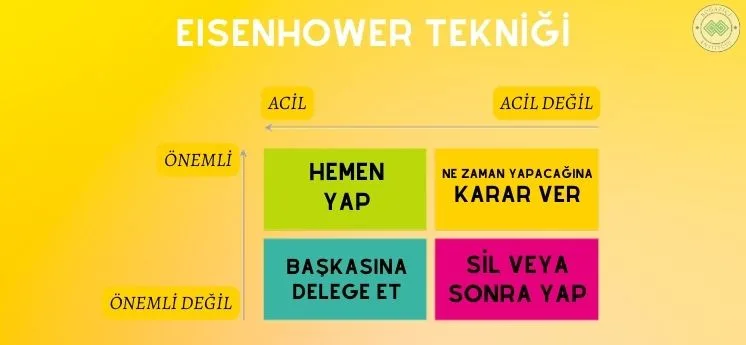
We shouldn't treat every task the same way, whether it's important or trivial. For example, say your list has a work task, checking email, and reading 10 pages of a book. The easiest thing on that list is the 10 pages. But the work task was actually the most important one — so if we do the lower-priority task during our most productive hours, we've essentially thrown our productive hours in the trash.
Ranking Tasks by Importance and Urgency — the Eisenhower Matrix
 via Boğaziçi University
Calendar (Helps Us Plan)
Looking at a calendar to see our tasks and deadlines lets us see what's ahead and gives us a clear sense of what to do and when. It reminds you of deadlines and takes the extra burden of remembering off your brain.
 via Google Calendar
Calendars are great for tracking deadlines and routines. If your system isn't rock solid, putting every single task on the calendar means that one delay can throw off your entire plan. It's more useful to put in the big tasks and the routine ones.
Taking Notes (Keeps Us From Forgetting)
Writing down the ideas that come to us, and generally the things we learn, saves extra mental effort and relaxes our brain. This way, we can keep fear and stress under control. Keeping our notes clean and organized will make life easier for us down the road.
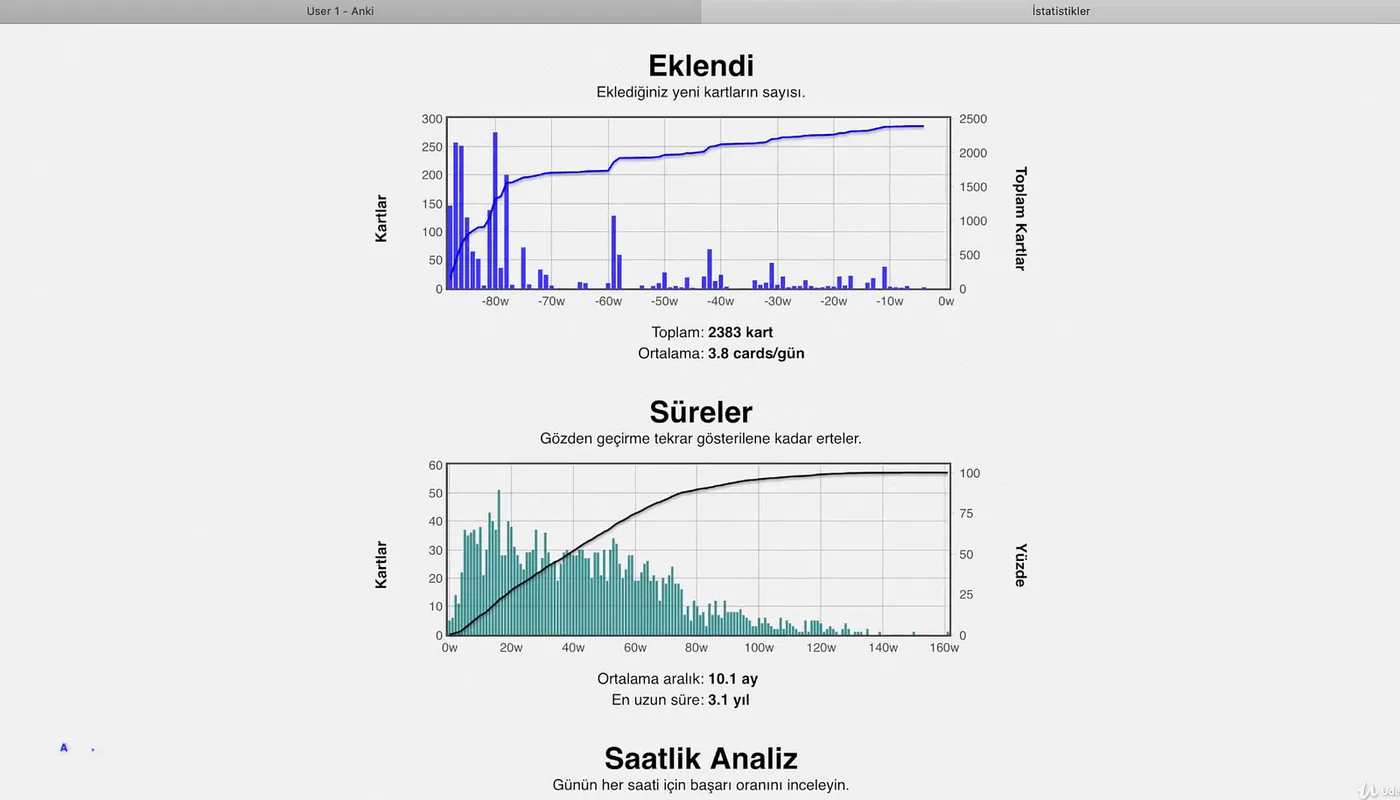 An Example App for Reviewing Our Notes (Anki)
Information recorded consistently gets tracked consistently. The Fantastic Trio gives us exactly that. Keep it in mind 🙂
Habit and Mood Triggering
Building a specific routine — waking up at the same time and doing the same things every day — lifts our mood and gets our brain and body actually supporting us. Instead of doing everything at once, it has to be done one thing at a time.
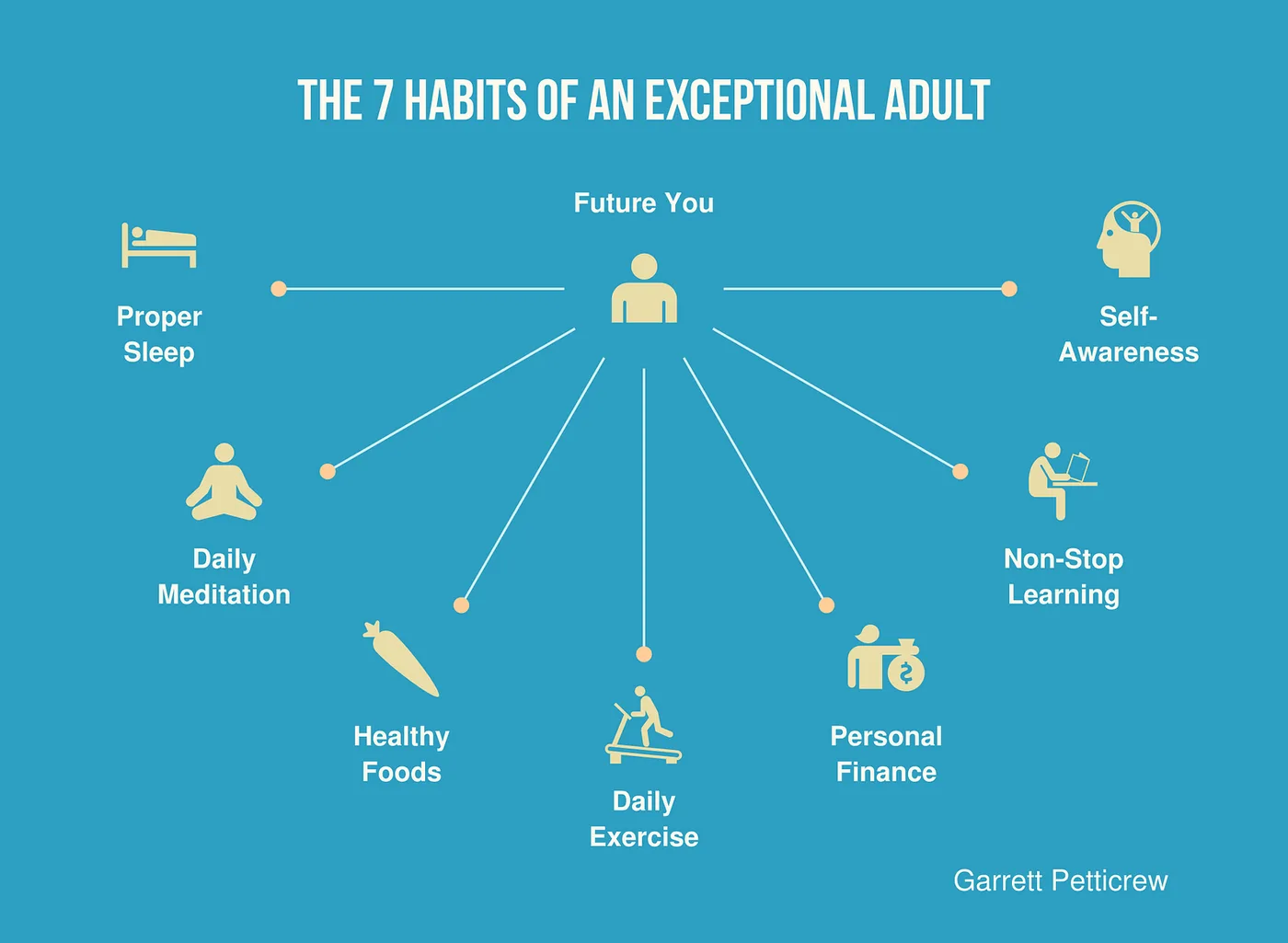 via Habits — Garrett Petticrew
Building a habit is hard. It feels difficult at first and demands consistency, but once you can pull it off even once, you come out ahead.
Mood Triggering
When our mood is good, we fight problems and setbacks much better. If our mood is low before we start working, there are simple things we can do to lift it.
- Deep Breathing: Clean oxygen, a full exchange of air. Blood flow balances out and stress decreases.
- Drinking Water: Creates clearer thinking and refreshes the brain. +Happiness
- Taking a Walk: Balances blood flow, promotes clearer thinking.
- Personal Triggers: Things that vary from person to person. For me, it's making progress at work.
Our Enemies in Time Management
Multitasking [The Performance Thief]
We want to finish everything at once. Sometimes we work on several things at the same time. This is actually a big mistake. Our brain has a limited resource. If we split it, our error rate goes up.
Research shows people who work this way develop concentration issues. This can genuinely be harmful to the brain. This doesn't apply to every task, though. See;
- Working while chewing gum. ✅
- Writing a report while checking email at the same time ❌
Notifications and How to Manage Them [The Attention and Focus Killer]
Smartphones are especially good at this. A message notification, or a social media like, is basically engineered to grab our attention instantly.
Research shows the distraction caused by a single notification can last up to 15 minutes. From the moment that vibration hits, we can't relax until we know what it actually is. This whole thing generates stress for us.
Let's identify the notifications that break our focus, one by one, and turn them off on our phones. Let's mute a few chat groups. We need to stay focused while working, and turning off your internet is a temporary fix for that.
Filling Dead Time [The Time Thief]
We call free time that could be put to use "dead time." Think commuting to and from work, aimlessly scrolling social media, or time spent waiting in line — those are all dead time.
Things to Do With Dead Time
- Review your goals, dreams, and plans.
- Review and update your to-do list or the tasks on your calendar.
- Jot your ideas down into notes so you don't lose them.
- Watch motivational videos or listen to useful podcasts.
- Read a book or listen to an audiobook.
Every Useful Activity Fuels Motivation for the Next One.
Indecision [The Hour-Eater]
Every decision consumes a certain amount of brain performance. We should be spending that on our goals. If we stay indecisive, we've wasted that effort for nothing.
Take something as small as deciding what to wear today — some sources put a figure of hours on that kind of indecision. People spend an enormous amount of time being indecisive. We think about things for hours.
Steve Jobs and Einstein reportedly wore pretty much the same outfit every day. 🙂
Final Thoughts and Last Tactical Notes
- Set a deadline for every task you need to do.
- Question every task you spend time on: "How much time (+money, respect, etc.) will this earn me down the road?"
- Plan ahead so you stay on top of how time passes.
- When you plan, first write down every one of your goals, then shrink each goal down until it becomes a short-term, doable task — as you shrink it, pick the paths that are optimal given your time and resources, implement the plan, and revisit and refine it as you go.
- Starting a task requires extra energy — be aware of this, and use reward and motivation to help generate that energy.
- Thinking "I should do this" actually pushes you further from doing it, so either do the task right away, or plan the exact day you'll do it.
- Put your hardest tasks in the early morning and your easy tasks later (brain energy keeps declining the longer you're awake).
- Sleep and wake at the same time every day; if that's not possible, sleep in multiples of 90 minutes.
- Whenever you can, take a 30-minute power nap in the afternoon.
- Stay away from blue and white light before bed, and sleep somewhere cool and dark.
- Drink at least 3 liters of water a day and carry a water bottle.
- Work for 25 minutes and rest for 5. Do that for 2 hours, then take a 30-minute break.
- During breaks, do things that rest your brain. (Walking, calm classical music, lying down, …)
- For extra productivity, challenge others on tasks you need to do, or make them witnesses to your own challenge, and follow through on the penalty if it doesn't happen.
- Put deadlines and routines into your calendar.
- Move the tasks tied to your goals into a daily to-do list.
- Write down important information as notes and keep your notes organized.
- When emotions keep you from working, try to understand that emotion and find a solution. Usually it's anxiety about the future creating fear and stress that stops our brain from working. Control the emotion by remembering that not working creates even bigger stress and fear.
- Look at things positively and see the glass as half full.
- Build daily habits that lift your mood during the hours you work each day.
- Stand taller and more confidently — use your body language to lift your mood.
- Don't multitask — the brain can only focus on one thing at a time.
- Keep your phone notifications under control at all times, and don't let them distract you while working.
- Fill dead time, like your commute, with useful things.
- Avoid indecision, and take precautions every day against the things you tend to waffle on.
- Remember the 80/20 rule — that 80% of results come from 20% of causes — and focus on that 20% so what you do in life becomes more results-driven.
This turned out a bit long, but if it was useful, I couldn't be happier. Grateful that you read this. Take care, friends...