You'll learn the core, essential fundamentals of Bubble Sort, Selection Sort, Quick Sort, Insertion Sort, Heap Sort, and Merge Sort.

For developers, sorting algorithms play a vital role in data processing and optimization. In this article, we'll briefly cover the six most important sorting algorithms, ones that offer effective solutions across different scenarios and datasets, along with their core characteristics and use cases.
Bubble Sort
Bubble Sort is one of the simplest sorting algorithms. It works on the principle of repeatedly comparing adjacent elements and swapping them when needed. This algorithm is mostly used for small datasets and for teaching purposes.
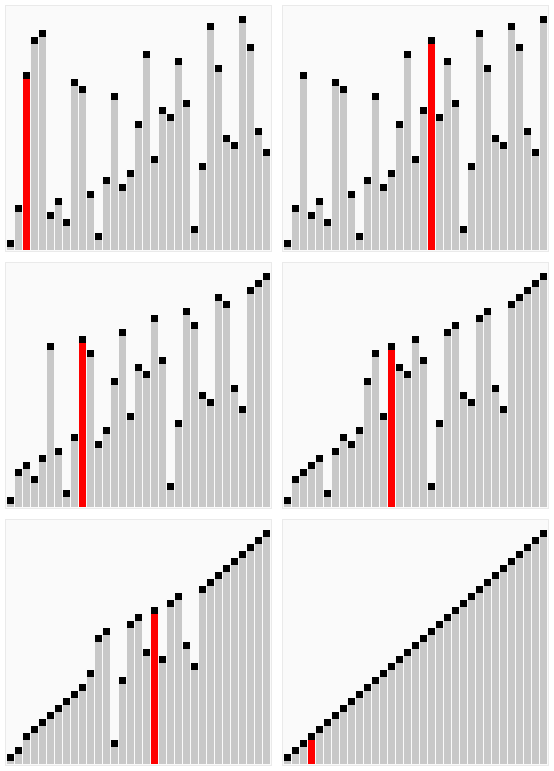 Bubble Sort Example
Bubble Sort Implementation (C#)
public int[] BubbleSort(int[] arr)
{
    int n = arr.Length;
    for (int i = 0; i < n - 1; i++)
    {
        for (int j = 0; j < n - i - 1; j++)
        {
            if (arr[j] > arr[j + 1])
            {
                int temp = arr[j];
                arr[j] = arr[j + 1];
                arr[j + 1] = temp;
            }
        }
    }

    return arr;
}
Advantages:
- Simplicity: The algorithm's logic is very simple and easy to understand.
- Low memory usage: Requires no extra memory — it's an in-place sort.
- Good for small datasets: Delivers acceptable performance on small, nearly sorted datasets.
Disadvantages:
- Inefficiency: Can be very slow for large datasets (O(n²)).
- Suboptimal usage: Other, more efficient algorithms are generally recommended instead.
- Low performance: Runs slowly in the average and worst cases.
Selection Sort
Selection Sort finds the smallest or largest element at each step and places it at the front of the unsorted portion. It's a slow algorithm, but it's quite easy to understand.
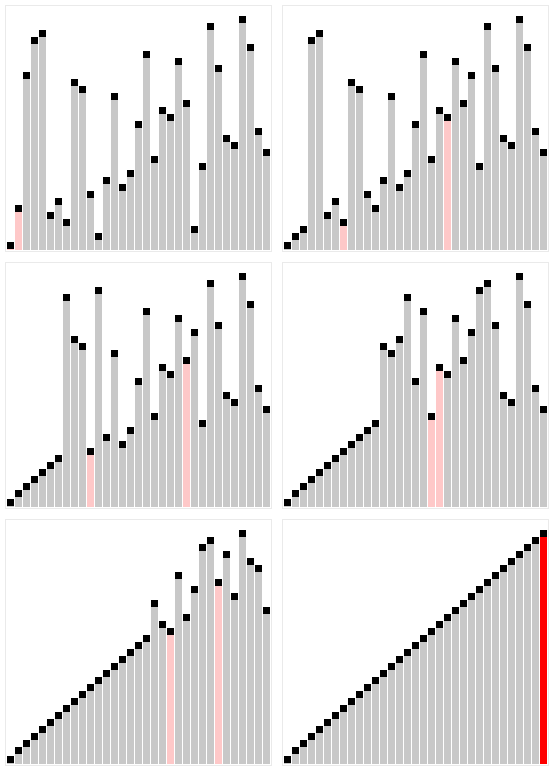 Selection Sort Example
Selection Sort Implementation (C#)
public int[] SelectionSort(int[] arr)
{
    int n = arr.Length;
    for (int i = 0; i < n - 1; i++)
    {
        int minIdx = i;
        for (int j = i + 1; j < n; j++)
        {
            if (arr[j] < arr[minIdx])
            {
                minIdx = j;
            }
        }
        int temp = arr[minIdx];
        arr[minIdx] = arr[i];
        arr[i] = temp;
    }

    return arr;
}
Advantages:
- Simplicity: Easy to understand and implement.
- Low memory usage: Requires no extra memory — it's an in-place sort.
- Nearly sorted data: Can be efficient when most of the dataset is already sorted.
Disadvantages:
- Inefficiency: Slow for large datasets (O(n²)).
- Unstable sort: The algorithm isn't stable, meaning the order of equal elements can change.
- Suboptimal usage: More efficient algorithms are generally preferred.
Quick Sort
Quick Sort is one of the fastest sorting algorithms, working on a divide-and-conquer approach. It's highly effective on large datasets and is used in many standard libraries.
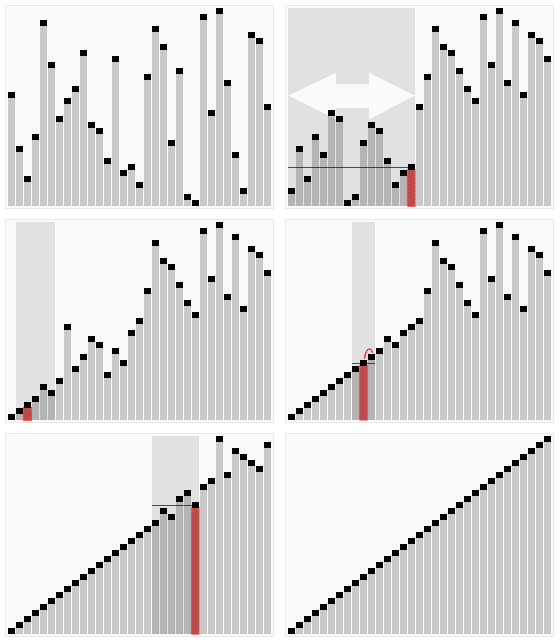 Quick Sort Example
Quick Sort Implementation (C#)
public int[] QuickSort(int[] arr, int low, int high)
{
    if (low < high)
    {
        int pi = Partition(arr, low, high);
        QuickSort(arr, low, pi - 1);
        QuickSort(arr, pi + 1, high);
    }

    return arr;
}

private int Partition(int[] arr, int low, int high)
{
    int pivot = arr[high];
    int i = (low - 1);
    for (int j = low; j < high; j++)
    {
        if (arr[j] < pivot)
        {
            i++;
            int temp = arr[i];
            arr[i] = arr[j];
            arr[j] = temp;
        }
    }
    int temp1 = arr[i + 1];
    arr[i + 1] = arr[high];
    arr[high] = temp1;
    return i + 1;
}
Advantages:
- Speed: Very fast on average (O(n log n)).
- In-place sorting: Requires no extra memory.
- General purpose: Performs well on both large and small datasets.
Disadvantages:
- Worst-case performance: Can take O(n²) in the worst case, especially with poor pivot selection.
- Recursive structure: Heavy use of deep recursive calls can cause a stack overflow.
- Unstable sort: The algorithm isn't stable — the order of equal elements can change.
Insertion Sort
Insertion Sort is quite efficient on small datasets and works in a way similar to sorting a hand of cards. At each step, an element is picked and placed into its correct position.
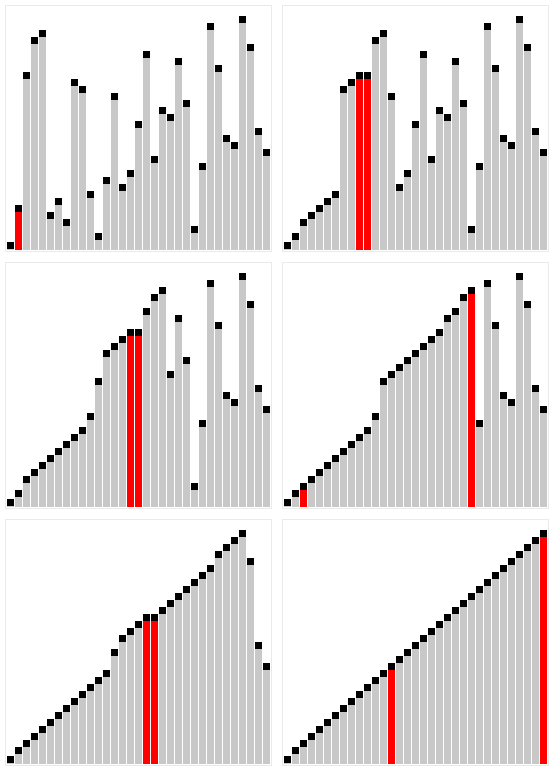 Insertion Sort Example
Insertion Sort Implementation (C#)
public int[] InsertionSort(int[] arr)
{
    int n = arr.Length;
    for (int i = 1; i < n; ++i)
    {
        int key = arr[i];
        int j = i - 1;
        while (j >= 0 && arr[j] > key)
        {
            arr[j + 1] = arr[j];
            j = j - 1;
        }
        arr[j + 1] = key;
    }

    return arr;
}
Advantages:
- Simplicity: Easy to understand and implement.
- Good for small datasets: Runs very fast on small, nearly sorted datasets.
- In-place sorting: Requires no extra memory.
Disadvantages:
- Inefficiency: Slow for large datasets (O(n²)).
- Unstable sort: The algorithm isn't stable — the order of equal elements can change.
- Suboptimal usage: More efficient algorithms should be preferred for large datasets.
Heap Sort
Heap Sort is a sorting algorithm that works using a priority-queue-style data structure. It aims to reduce complexity by using the heap data structure. This algorithm can be effective on large datasets.
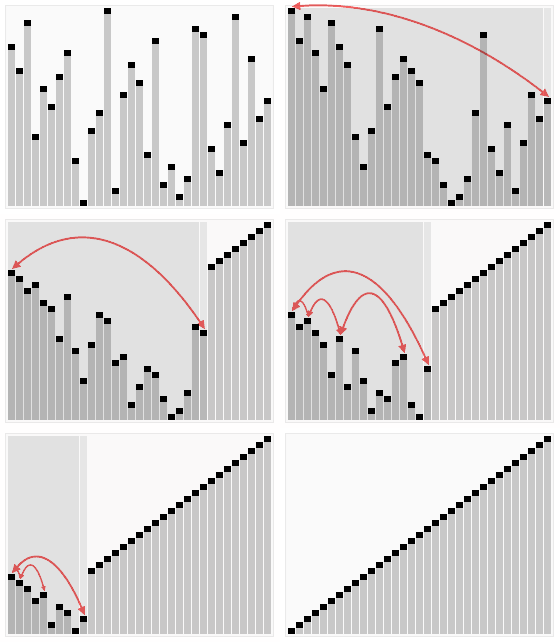 Heap Sort Example
Heap Sort Implementation (C#)
public int[] HeapSort(int[] arr)
{
    int n = arr.Length;
    for (int i = n / 2 - 1; i >= 0; i--)
        Heapify(arr, n, i);
    for (int i = n - 1; i >= 0; i--)
    {
        int temp = arr[0];
        arr[0] = arr[i];
        arr[i] = temp;
        Heapify(arr, i, 0);
    }

    return arr;
}

private void Heapify(int[] arr, int n, int i)
{
    int largest = i;
    int left = 2 * i + 1;
    int right = 2 * i + 2;
    if (left < n && arr[left] > arr[largest])
        largest = left;
    if (right < n && arr[right] > arr[largest])
        largest = right;
    if (largest != i)
    {
        int swap = arr[i];
        arr[i] = arr[largest];
        arr[largest] = swap;
        Heapify(arr, n, largest);
    }
}
Advantages:
- Speed: Runs with O(n log n) time complexity.
- In-place sorting: Requires no extra memory.
- General purpose: Performs well on both small and large datasets.
Disadvantages:
- Complexity: Its logic and implementation are more complex than other simpler algorithms.
- Unstable sort: The algorithm isn't stable — the order of equal elements can change.
- Harder to implement: More difficult to implement than other, simpler algorithms.
Merge Sort
Merge Sort is another effective sorting algorithm that works on the divide-and-conquer approach. It works through splitting and merging steps and is highly effective on large datasets.
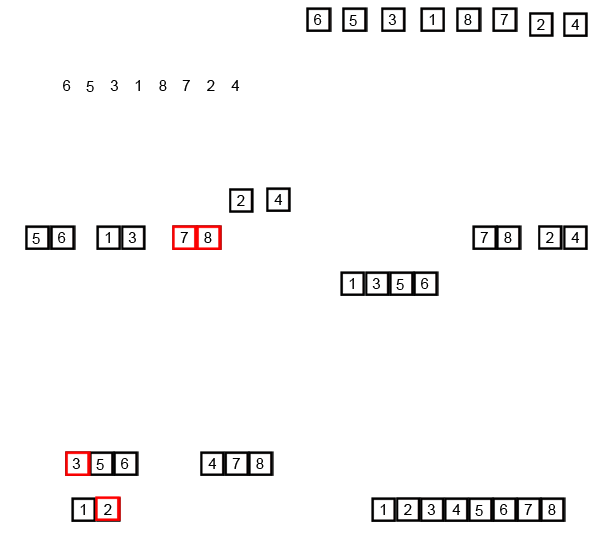 Merge Sort Example
Merge Sort Implementation (C#)
public int[] MergeSort(int[] arr, int left, int right)
{
    if (left < right)
    {
        int mid = (left + right) / 2;
        MergeSort(arr, left, mid);
        MergeSort(arr, mid + 1, right);
        Merge(arr, left, mid, right);
    }

    return arr;
}

private void Merge(int[] arr, int left, int mid, int right)
{
    int n1 = mid - left + 1;
    int n2 = right - mid;
    int[] L = new int[n1];
    int[] R = new int[n2];
    for (int i = 0; i < n1; ++i)
        L[i] = arr[left + i];
    for (int j = 0; j < n2; ++j)
        R[j] = arr[mid + 1 + j];
    int k = left;
    int i = 0, j = 0;
    while (i < n1 && j < n2)
    {
        if (L[i] <= R[j])
        {
            arr[k] = L[i];
            i++;
        }
        else
        {
            arr[k] = R[j];
            j++;
        }
        k++;
    }
    while (i < n1)
    {
        arr[k] = L[i];
        i++;
        k++;
    }
    while (j < n2)
    {
        arr[k] = R[j];
        j++;
        k++;
    }
}
Advantages:
- Speed: Runs with O(n log n) time complexity.
- Stable sort: The algorithm is stable — the order of equal elements is preserved.
- Large datasets: Performs very well on large datasets.
Disadvantages:
- Memory usage: Requires extra memory, meaning it doesn't sort in place.
- Complexity: Its logic and implementation are more complex than other simpler algorithms.
- Recursive structure: Heavy use of deep recursive calls can cause a stack overflow.
Understanding the advantages and disadvantages of each algorithm can help you decide which algorithm is best suited to which situation. Keep in mind that algorithms like Bubble Sort and Selection Sort are simpler and better suited for teaching purposes, while algorithms like Quick Sort and Merge Sort are more effective on large, complex datasets. Heap Sort, meanwhile, is preferred especially when working with heap data structures. Insertion Sort is ideal for small or nearly sorted datasets.
By learning this broad range of sorting algorithms, you can make better decisions throughout your software development process. Feel free to put this knowledge to use in your course materials, coding projects, or algorithm competitions.
I meant to keep this brief, but it still turned into a long article. I'm grateful you took the time to read it. Take care, friends...